
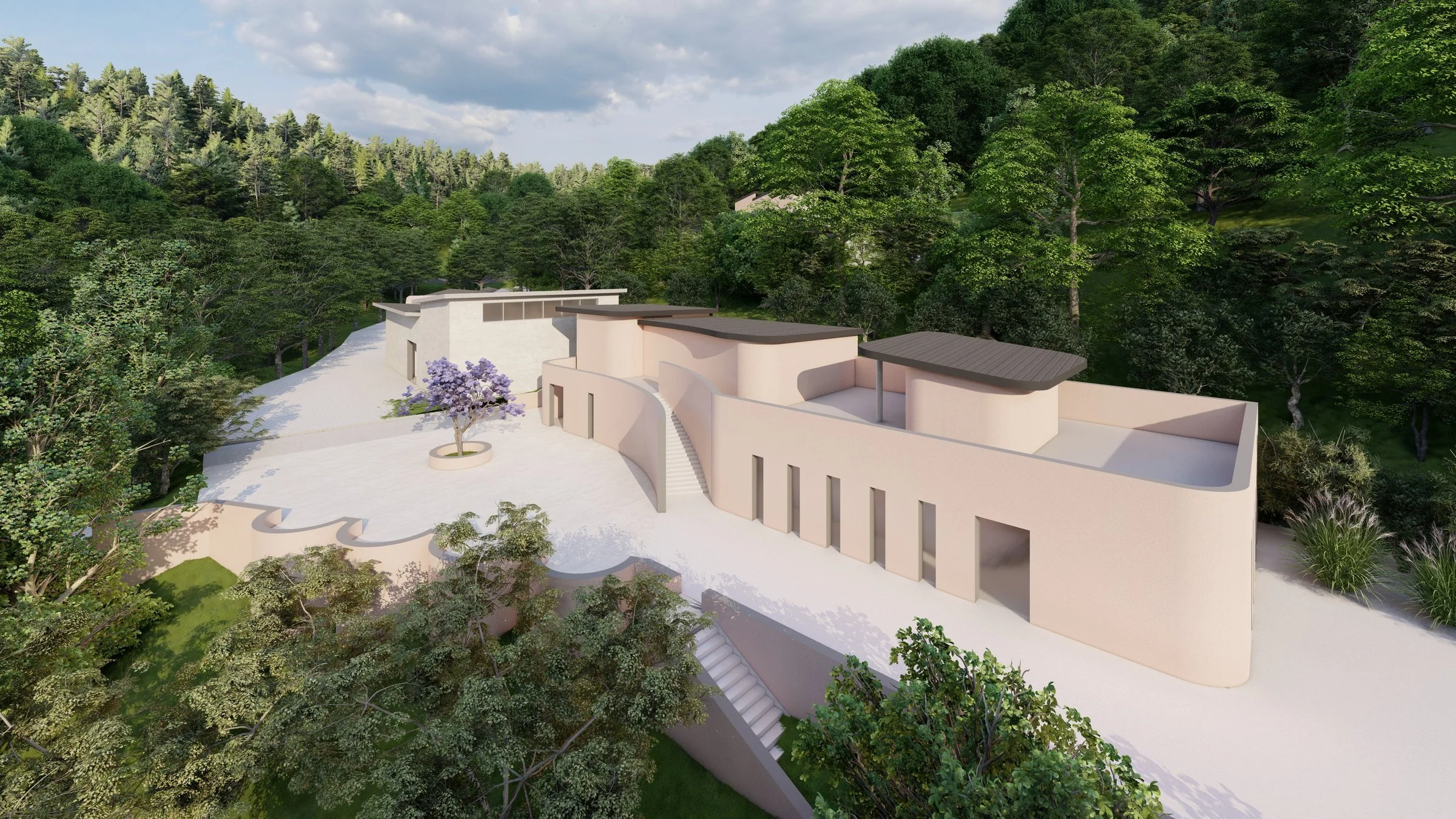
Rendering — the buildings on the hillside, seen from above (masterplan, 2025)
A few weeks ago, I tried to explain a project to a friend who does not speak Korean. We were in a café in Hannam-dong. He had asked, politely, what I was working on. I started with the easy parts — it is a kind of complex, outside Cheonan, on a valley site — and then ran straight into a wall I have been running into for over a year.
The wall is the project’s name.
The project is called Majung (마중). And the moment I had to translate the word, I realised I had no good way to do it.
What the Word Means
In Korean, 마중 is the act of going out to meet someone who is on their way to you. Not greeting them at the door — that comes later. Majung is what happens before. It is leaving the house, walking to the end of the alley, scanning the road for the person you are waiting for.
A mother goes out to majung her child returning from school. A daughter goes out to majung her father coming home from a long trip. The word holds anticipation, tenderness, and a small physical gesture: the body in motion, going out toward someone not yet here.
English does not really have this word. Welcome happens at the threshold. Greet happens at the point of contact. Meet is neutral — too flat to carry what majung carries. The closest I can get is something like “going out to meet,” which is not a word so much as a description, and even then the warmth is gone.
This matters, because the entire project is built around it.
The Brief in One Sentence
The client described the place to me, very early on, in a single sentence I have been carrying with me since:
A space where our companion animals play joyfully now, and later come out to majung us.
I want to sit with the grammatical inversion in that sentence for a moment. In ordinary use, a person does majung. The mother goes out to meet the child. Here, the animals do majung. They are the ones at the end of the alley, scanning the road.
In a typical hospice or memorial, the design serves the bereaved. The space organises grief on the side of the living. Majung asks something stranger: build the space as if the animals who passed through it are still there, still moving, still walking out to meet whoever arrives next.
This is not metaphor. It is a brief.
I have spent a long time trying to design buildings that say something. This is the first time I have been asked to design a building that waits for someone.
Walls, Gravity, and All The Rest of It
I owe the readers of this log a small honesty. I have promised this project three times now — in December, at New Year, and in April — and each time I deferred, because the project was either too early or I was too tired to write about it well. So here are the load-bearing facts, finally.
The site is a valley a couple of hours south of Seoul. The brief brings together programmes that rarely share a site: a place where companion animals can play and stay, a hospice for animals at the end of life, a funeral facility, and a small digital memorial layer that connects the physical space to families who cannot always be there. The first phase, now in design, is the funeral and memorial building, on the site of the old warehouse; play, stay and the hospice come later.
Each of those programmes has its own architectural literature. I have not found them written about together. There is no obvious precedent I can lean on — no Therme Vals, no Brion Cemetery, no Yusuhara — that solves the problem of holding play, care, and farewell on one site without one programme quietly erasing the others.
This is the first project where I have felt the weight of the gap between what is written and what is being asked.
On Translation Generally
I have been thinking about translation a lot lately — not just the language kind. A building is, in a way, a translation: of a brief, of a site, of a conversation between people who often want different things from the same room. Some briefs translate easily. Others come with a word at their centre that does not have an equivalent in the language of construction.
For Majung, the translation problem is not really linguistic. It is architectural. How do you build a place that waits? How does a wall carry anticipation? How does a path imply that someone is walking toward you from the other end of it?
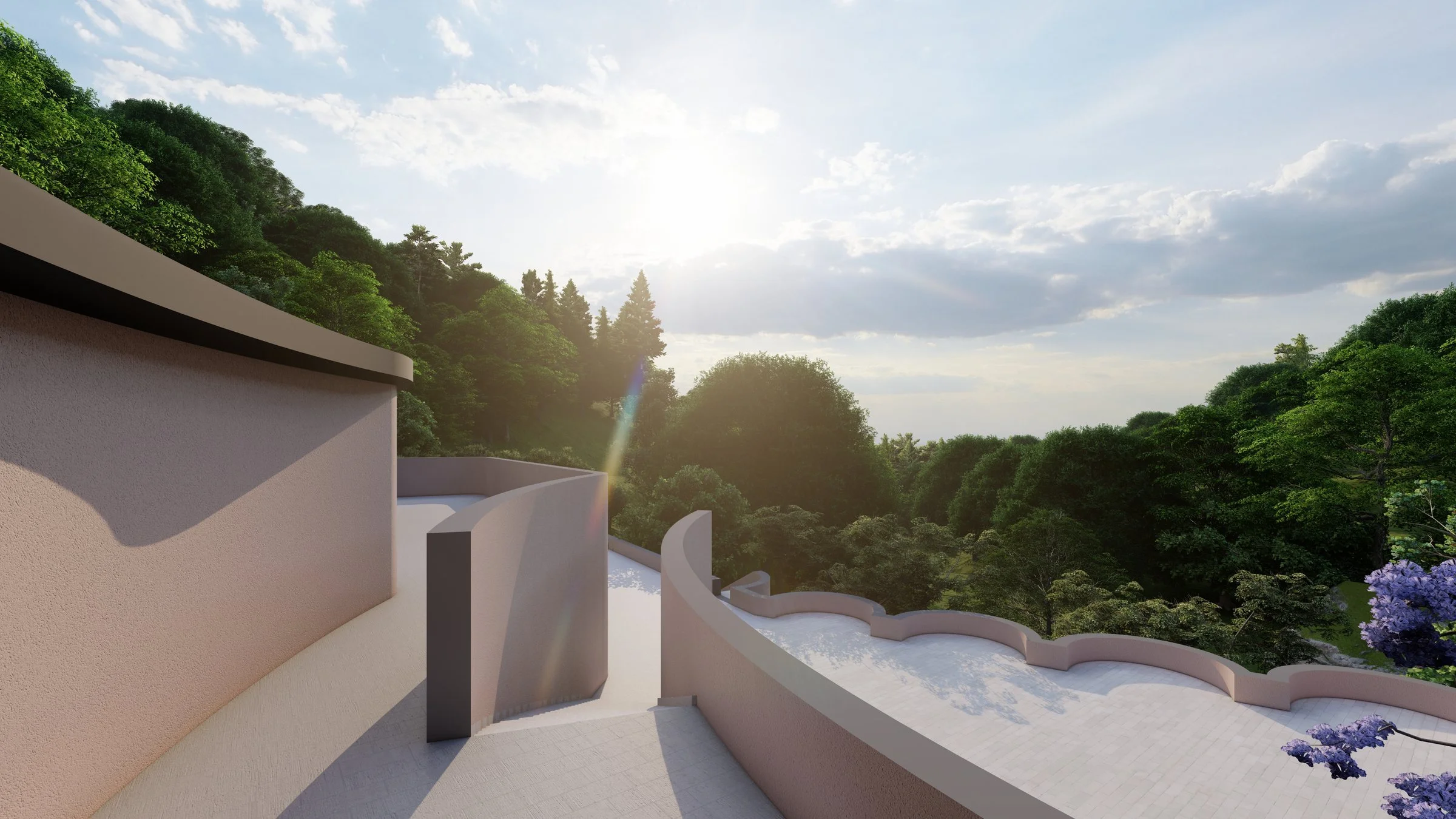
Rendering — curved terrace walls facing the valley (masterplan, 2025)
I do not yet know. That is the work.
What Comes Next
This is the first of what will be a few posts on Majung. The project has moved from masterplan into the design of its first phase, and I would rather write as it develops than try to summarise something that is genuinely still being made.
The next post in this series will be on the hospice — the smallest building on the site, and the one I think about most. After that, the integration question: how play and farewell live on the same ground without diluting either.
For now, I just wanted to put the word down.
Majung.
A word I cannot translate, on a project that is teaching me what translation actually means.
Thank you for reading.
Project page: Majung — Yuseong Tourist Farm, Cheonan
